

26 février 2012
Publicité
Publicité
12 février 2012
i4D ... téléportation ?
 Un communiqué SESAResque attire notre attention " Only two and a half years into active SESAR development work, today the first initial four dimensional (I-4D) trajectory flight successfully took place. Thanks to the complementary expertise of the involved SESAR members (Airbus, Eurocontrol, Honeywell, Indra, NORACON1, and Thales), the Airbus A320 test aircraft taking off from Toulouse to Copenhagen and Stockholm, successfully validated the capability of the aircraft system to comply with time constraints elaborated and negotiated with ground ATC system through air ground datalink communication. I-4D is a cornerstone of the SESAR programme as it is the first step towards more predictable flights. "
Tiens, sympa, en plus il y a Thales et Airbus ... cherchons donc à en savoir plus, c'est quoi ce vol ?
LFBO-EKCH-ESSA ... ça passerait pas par chez nous ça ? :-)
Pourtant, parti de Toulouse, l'A320 s'est téléporté dans l'espace du MUAC où les systèmes bord et sol ont coordonné un CTO (Constraint Time Over) sur un point de début de descente CDA vers EKCH puis l'opération a été répétée sur ESSA.
N'est-il pas surprenant que le trial n'ait retenu que le succès des échanges d'informations 4D via datalink ou la validation du mode de présentation des informations au pilote et aux controleurs ? Ils sont vraiment bizarre nos partenaires quand même, pendant qu'ils peinent à réaliser un unique vol i4D, nous on joue à Captain Kirk et Mr Spock ! ... "Beam me up Scooty !"
12 février 2012
ATSAW ... Pôle Emploi bonjour ?
ATSAW (Airborne Traffic Situational Awareness) ... vers l'autoséparation à l'horizon 2025 ou comment bientôt les équipages auront plus d'informations sur le traffic environnant que nous n'en aurons sur nos écrans !
C'est à lire sur Flightglobal ...
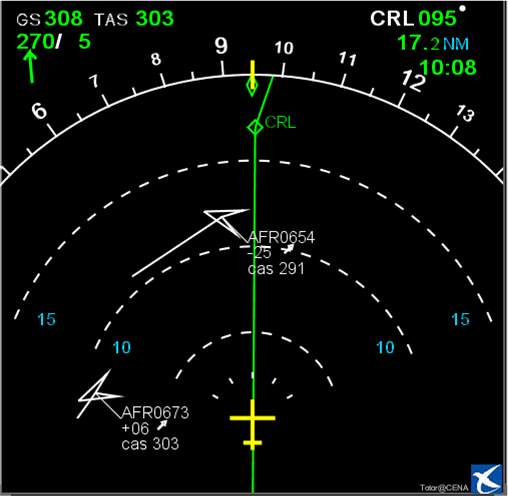 "Swiss International Airlines has just operated the first commercial flight equipped with an approved traffic situational awareness system, providing the pilots with a real-time picture of surrounding traffic on their navigation display.
On 7 February a Swiss Airbus A330-300 equipped with European Aviation Safety Agency certificated airborne traffic situational awareness (ATSAW) system flew from Zurich Airport to Montreal.
The aircraft was taking part in the Eurocontrol CASCADE programme's ATSAW pioneer project, which will involve 25 Airbus and Boeing aircraft belonging to British Airways, Delta Air Lines, Swiss, US Airways and Virgin Atlantic. It also involves the UK and Icelandic air navigation service providers, NATS and ISAVIA, as they provide ATC services for a large area of the North Atlantic where the most significant and most immediate advantages from ATSAW can be delivered.
ATSAW provides pilots with a real-time picture of the surrounding traffic during all phases of flight, including aircraft identification, flight level and track. On Oceanic routes where air traffic control has no radar picture of traffic, ATSAW enables the pilots to identify opportunities for a safe climb or descent through traffic to a more fuel-efficient or turbulence-free altitude, although they will still have to request clearance for the manoeuvre from ATC. Eurocontrol said ATSAW will also support visual separation on approach, and it will be able to provide traffic situational awareness on the airport surface.
The technology employed in the Swiss A330 ATSAW is automatic dependent surveillance-broadcast-in (ADS-B In), which picks up signals from other aircraft transponders or ADS-B-Out. Airbus provided the ATSAW used by Swiss, and its traffic information is integrated with the navigation display, but an ATSAW display can be provided on a Class 2 or Class 3 electronic flight bag screen. Honeywell provides the traffic computer.
Eurocontrol explained: "ADS-B is a surveillance technique allowing aircraft to broadcast their identity, position and other information derived from on-board systems. This signal can be captured for surveillance purposes from the ground through ADS-B Out, or viewed on board other aircraft through ADS-B In. ATSAW enables traffic situational awareness, spacing, separation and self-separation applications."
The ultimate intention under the Single European Sky programme is that ATSAW, backed with other sensor equipment, will enable pilots to conduct their own separation, but this is not expected to be achieved until about 2025."
1 février 2012
Are you ready for XMAN ?
 After a one-week trial period Air Traffic Control the Netherlands (LVNL) and the Maastricht Upper Area Control Centre (MUAC) implemented the Arrival Management Message AMA, an extension of LVNLs Arrival Manager into MUACs Upper Airspace. This is an innovative milestone for the further development of the air traffic management system in the FABEC airspace.
An AMA message is sent electronically from Amsterdam to the Maastricht ATC system and contains essential information for managing air traffic inbound to Schiphol. The data received enables air traffic controllers to issue speed instructions at an early stage during the descent to destination. This results in a streamlined amount of traffic, improves flight efficiency, and can result in savings up to 110 kg of fuel per flight affected.
The introduction of AMA-messaging is an essential step in the implementation of a function in the air traffic management system that advises air traffic controllers about aircraft speed and the use of routes for aircraft inbound to Schiphol while they are still flying in the upper airspace. This function is being developed in the Speed And Route Advisor (SARA) project; one of the projects which are carried out at European level, as part of the strategy of the European Commission, with the aim to modernise the air traffic management system in the period until 2020. The implementation of this function makes traffic flows more predictable and stable, reduces the workload of air traffic controllers and cockpit crew and brings environmental and economical benefits.
For FABEC, the new data exchange between Amsterdam and Maastricht is an initial step to implement cross-border arrival management (XMAN) for the five major airports Paris, Frankfurt, Amsterdam, Munich and due to its effect on FABEC operations London. The objective is to improve flight efficiency by enhancing the scope of continuous decent operations (CDO). Instead of the limited range of existing centre-internal arrival management systems XMAN will allow the planning of arrivals across centre boundaries within a range of approximately 200 nautical miles.
1 février 2012
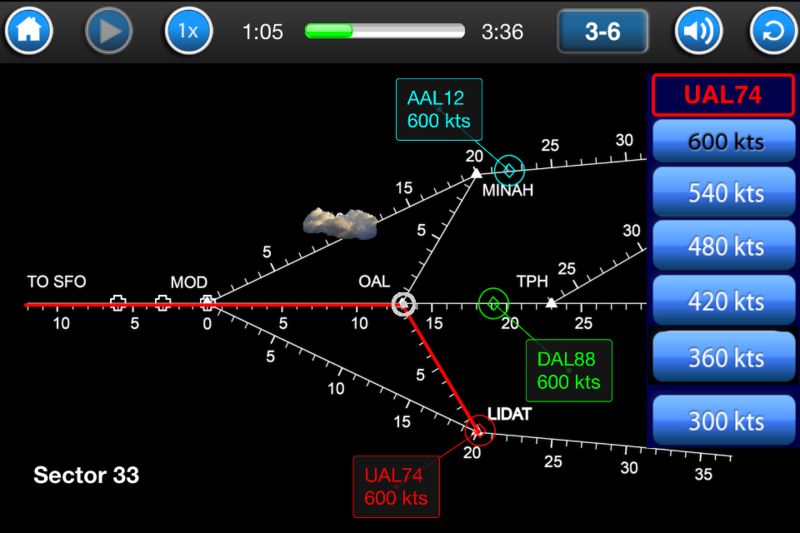
Can you handle Sector 33 ?
 Afin de faire partager l'importance des sciences et des mathématiques aux étudiants américains, la NASA a choisi de prendre le contrôle aérien en exemple. Cela débouche sur une appli iphone qui va devenir un must have : Sector 33 ...
"Our hope is that Sector 33 will give students a sense of the importance of math in managing our nation's air traffic and, at the same time, interest them in pursuing a career in aeronautics."
C'est bien sûr gratuit et sur l'App Store : Sector 33
Publicité
Publicité
22 janvier 2012
Quand le PE s’intéresse aux capacités techniques des ANSP ...
 Nous ne sommes visiblement plus les seuls à nous étonner du manque de fonctionnalités de nos systèmes techniques de contrôle aérien.
Dans les questions qui sont reproduites ci-dessous un député européen semble lui aussi être dubitatif de l'écart entre les informations disponibles et rendues obligatoires pour l'équipement des usagers (Mode S; ADS-B) et l'utilisation qu'en font les ANSP.
Une façon comme une autre de relayer nos propres interrogations : "Comment se fait-il que l'on doit ouvrir flightradar24.com pour trouver des infos que nous n'avons pas sur nos radar ?"
Un récepteur ADS-B ... 500€ !
| Subject: Single European Sky Implementing Rules on Aircraft Identification and Surveillance Performance | |||||||||||
|
Two regulations laying down new Single European Sky Implementing Rules (IR) related to SESAR have been published in the EU Official Journal:
Therefore following questions to the Commission:
|
|||||||||||
La réponse de la CE en application de la règle 117, doit intervenir dans les 6 semaines ... à suivre donc.
9 janvier 2012
Taux redevances 2012 et UDS
Cher blogreaders, vous avez pu constater que les posts se faisaient rares ces derniers temps. Je le regrette autant que vous mais ce n'est pas un soudain désintérêt pour la chose controllistique qui en est à l'origine. Disons au contraire que je suis un peu occupé par ailleurs ! :-)
Cela ne m'empêchera pas de vous souhaitez à tous une très bonne année 2012, quelle soit riche en satisfactions aéronautiques de tous ordres !
Et en bonus, une petite mise à jour de l'évolution des redevances et UDS :
- Le tx de nos amis suisses s'envole mais le tx de conversion CHF/€ n'y est probablement pas pour rien.
- La crise semble ignorer la Turquie ... qui pourrait être le 3ième prestataire en Europe dès l'année prochaine


29 novembre 2011
Progress Report on SES Implementation
 La commission européenne nous informe sur la mise en oeuvre du SES, FAB et des plans de performances ...
Section 1: Report on implementation of the Single European Sky legislation — "Time to deliver"
The European Commission has today warned that Member States and stakeholders will need to do more to ensure the Single European Sky (SES) becomes a reality. The report on the implementation of the Single European Sky concludes that more is still required to achieve full and timely implementation of the first package of legislation adopted in 2004. The main concerns relate to insufficient steps towards cross-border air navigation service provision, the lack of interoperability of air navigation systems and the lack of resources for national supervisory authorities as well as their low level of activity in monitoring the air navigation service providers.
Issues
Today's report provides a detailed "snap shot" of the implementation of the Single European Sky, which involves reforming the European Union's air traffic management (ATM) system.
The Commission identified in particular three areas of concern:
-
The lack of resources for National Supervisory Authorities leading to a low leve of monitoring activities of air navigation service providers should be addressed swiftly.
-
There remains a considerable lack of interoperability of air navigation systems leading to higher costs, barriers to the mobility of air traffic controllers and missed opportunities due to fragmented equipment markets.
-
The establishment of Functional Airspace Blocks (FABs), a concept of consolidation of service provision regardless of national borders. FABs still meet difficulties to be fully set up and functioning by December 2012. These blocks are essential for generating real benefits to airspace users and passengers by delivering cost savings and capacity enhancements.
Next steps
Member States are urged to confirm their commitments and to take action to make the Single European Sky implementation process a success. Failing to take measures at national level to achieve the Single European Sky would oblige the Commission to reopen the legislative packages in view of more radical solutions.
Background
The Single European Sky was launched with the adoption of a first package of legislation in 2004 (SES I) and followed up with a second package (SES II) in 2009. Although the Member States and stakeholders have already done a significant amount of work in the wake of the first package, there still remain many other measures that will need to be implemented.
As regards the second package, its successful delivery now relies on the timely implementation of its different components. Priority should be given to actions that will make the biggest contribution to performance, in particular:
-
the performance scheme (starting early in 2012)
-
the FABs (to be operational by end 2012)
-
the ATM network functions operated by the Network Manager (already in place)
-
the deployment of the SESAR programme (to start in 2014).
Map 1 – Functional airspace block progress
European Commission "traffic light assessment" of progress on functional airspace blocks (FABs).
Target: All 9 FABs to be fully operational by end-2012.
Result: All FABs in orange or red zones, except one (Denmark/Sweden)


Text of the recent recommendation of the Commission:
http://ec.europa.eu/transport/air/single_european_sky/doc/c2011-8329-recommendation.pdf
Text of the implementation report:
http://eur-lex.europa.eu/LexUriServ/LexUriServ.do?uri=COM:2011:0731:FIN:EN:PDF
Section 2: Report on the revision of targets contained in performance plans, with "traffic light" assessment of Member State performance plans.
The European Commission is calling on Member States to step up their efforts for the Single European Sky to avoid missing out on projected savings of nearly €1.2 billion by 2014. These savings are expected to benefit both airlines and travellers. Today the Commission issued recommendations to Member States to revise and further improve their performance plans so that EU-wide targets for the Single European Sky can still be achieved for the period 2012 to 2014. The Performance Review Body, which assessed national or functional airspace block (FAB) performance plans and targets, concluded that several national plans still fall short.
Issues
According to the assessment, the national performance plans would miss the EU-wide target for cost efficiency by 2.4% in 2014. To meet the target, additional measures are needed to achieve a €250 million saving over the entire three year reference period (2012–14).
Existing plans by Member States would also fail to meet the EU-wide target of 0.5 minute delay per flight in 2014. If this target was achieved, some €920 million would be saved over 2012–14 due to fewer and shorter delays.
Next steps
It is now up to Member States to revise their performance targets in line with the Commission's recommendations. In case of failure, the Commission may decide at a later stage that Member States have to take corrective measures.
Background information
The aim of the Single European Sky project is to put an end to the current fragmentation of Europe's sky in order to increase capacity and achieve cost-efficiency gains. In addition it will help to increase safety and reduce aviation's impact on the environment by making flights shorter and enabling airlines to cut back on fuel.
To this end, functional airspace blocks will be created in Europe. Member States are required to adopt performance plans to show how they will meet the EU-wide performance targets adopted by the Commission.
The independent Performance Review Body was set up by the Commission in July 2010 to assess these performance plans. Its assessment of national or Functional Aisrpace Block performance plans with performance targets for the period 2012–14 was delivered to the Commission on 20 September 2011.
The Commission is entitled to issue recommendations to Member States to adopt revised performance targets within four months after submission of the performance plans.
Frequently asked questions on Single European Sky performance targets
-
What is the importance of the performance scheme for the Single European Sky? How do airlines, passengers and European citizens benefit from the achievement of the EU-wide performance targets?
The performance scheme is a cornerstone of the Single European Sky. It aims at setting and implementing binding targets for Member States to deliver better air navigation services at lower cost. The incentives given through the performance scheme will lead to cheaper flights. Furthermore, the scheme ensures that capacity is increased. As a result, flights will be significantly less delayed, saving unnecessary costs for airlines and passengers. In addition, the environmental impact of air traffic will be reduced due to more efficient and shorter flight paths. Air travellers should benefit from a punctual, greener and more cost-efficient mode of transport with a maintained or even enhanced level of safety.
It has been estimated that during the three-year period 2012–14, airspace users will pay around EUR 19 billion on air navigation charges. Depending on the type of airline, air navigation charges represent between 6% and 10% of the airline’s operating costs. These are significant costs that are ultimately borne by passengers.
-
Why is the Commission issuing recommendations to Member States to change their performance plans?
The EU agreed in 2011, for the first time, EU-wide performance targets regarding cost-efficiency and capacity of air navigation services. Member States, either at national or functional airspace block level, had to present in summer 2011 performance plans that together deliver the agreed targets. The independent Performance Review Body assessed the national or functional airspace block performance plans. Their assessment report clearly shows that the aggregation of the national and functional airspace block performance targets will not allow reaching the agreed EU-wide targets in the period 2012–14. It is thus for the Member States to revise and further improve their targets.
The Commission has identified in its recommendation to Member States concrete areas for improving the performance plans in view of reaching the EU-wide targets. Member States now have two months to present revised performance plans. Depending on the assessment of the revised plans, the Commission may either approve them or ask for further modifications.
If Member States fail to deliver revised plans, the Commission may decide at a later stage that Member States have to take corrective measures. If necessary, the Commission may adopt a binding decision requesting the Member State(s) concerned to implement specific corrective measures.
-
Which Member States have to revise their national / functional airspace block performance targets?
Only the performance plans of Lithuania, Belgium, Luxembourg, The Netherlands and Denmark are in line with and contribute adequately to the EU-wide targets. Several Member States fulfil none or only one of the two targets: either the capacity or the cost-efficiency target. The table below shows for each Member State whether a target needs to be revised.
- Which performance targets are measured? Is it the first time that performance plans have been established?
The performance scheme was introduced with the Single European Sky legislative package in 2009 (i.e. SES II). For the so-called "first reference period 2012–14" EU-wide performance targets were agreed in the key performance areas of environment, safety, capacity and cost-efficiency. Even though environment and safety targets are not mandatory for performance plans during the first reference period, all plans contain substantial elements of environmental and safety performance.
It is the first time that Member States are required to set up performance plans. The revision of these plans following the Commission recommendation will allow for further improvements to the benefit of airlines and passengers in line with the agreed EU-wide targets.
TABLE 1 – Peformance Scheme Progress
European Commission "traffic light assessment" of Member State performance plans for ATM capacity (delays) and cost-efficiency
Target: Performance scheme meeting EU-wide targets to start early 2012.
Result: Only 5 Member States have submitted performance plans which would enable the EU-wide targets to be met. All others are in the orange or red zones.

16 novembre 2011
Rapport de Courson Nième
Comme tout les ans on lit avec intéret le rapport de M de Courson (LF2012) sur le volet Transports de la Loi de finances. C'est comme d'ahabitude, l'inquiétude en plus vis à vis de la dette ... tiens c'est pas de ce machin là dont on parle tout le temps aux infos ?
 "La direction générale de l’Aviation civile (DGAC), dont les activités sont financées par le budget annexe Contrôle et exploitation aériens (BACEA), se distingue à tout point de vue des autres administrations centrales : par ses activités quasi-commerciales (prestation de services aux acteurs du transport aérien contre le paiement de redevances), par son référentiel comptable (avec la volonté de substituer à la comptabilité de caisse une comptabilité en droits constatés), par la gestion de ses personnels (au moyen de « protocoles sociaux », forme de convention collective appliquée à des agents qui sont pourtant fonctionnaires de l’État). Tout cela milite en faveur de la transformation de la DGAC en établissement public. Après avoir envisagé cette hypothèse, le Gouvernement y a renoncé face à l’hostilité des organisations syndicales. Le Rapporteur spécial le regrette, d’autant que cette évolution statutaire serait cohérente avec l’intégration croissante de la navigation aérienne au niveau européen (s’agissant de la France, au sein du bloc d’espace fonctionnel d’Europe centrale, ou FABEC). Le budget annexe ne parvient pas à sortir de ce que la Cour des comptes n’a pas hésiter à qualifier de « spirale de surendettement ». Après avoir augmenté de 64 % entre 2001 et 2011, l’endettement progressera à nouveau en 2012, pour dépasser 1,2 milliard d’euros. Le budget annexe, structurellement déséquilibré, s’endette en partie pour financer son fonctionnement : en 2012, l’endettement augmentera de 250 millions d'euros, pour un montant d’investissements de seulement 197 millions. Au-delà des efforts encore possibles en matière de dépenses (notamment sur les coûteux protocoles sociaux), et sauf à obérer les capacités d’investissement de la DGAC, le désendettement du budget annexe passe par une augmentation de ses recettes. Il serait ainsi judicieux, dans un premier temps, d’affecter au BACEA l’intégralité du produit de la taxe de l’aviation civile. Cette mesure permettrait de compenser partiellement le sous-financement du budget annexe, dont certaines prestations devant être financées par des redevances ne le sont en pratique pas."
13 novembre 2011
Formation Continue
On n'est pas toujours copain avec nos voisins du NATS mais en matière de formation il faut reconnaître qu'ils sont plutôt bons.Ces deux petites vidéo devraient être reprises par nos sub Instruction.
Pour les amateurs, encore plus d'infos sur SKYbrary qui nous propose ces documents.
Flight Deck Procedure Normal Situations ... a guide for controllers
Flight Deck Procedure Abnormal Situations ... a guide for controllers
Publicité
Publicité
/https%3A%2F%2Fstorage.canalblog.com%2F72%2F56%2F65068%2F41200331_o.jpg)